James: How did this project come about, and was it always meant to be a one-shot movie?
Bastiaan: Yes, it was always meant to be a one-shot film. Around the time of On Air (a previous short of Bastiaan’s) we were at an award show at Pinewood Studios in London, and there an actor from my film was nominated alongside Steven Graham for Boiling Point, the short. And that was shot in one single take. So, from there, something started brewing and I thought, “oh, it would be cool to do a film in a single take”.
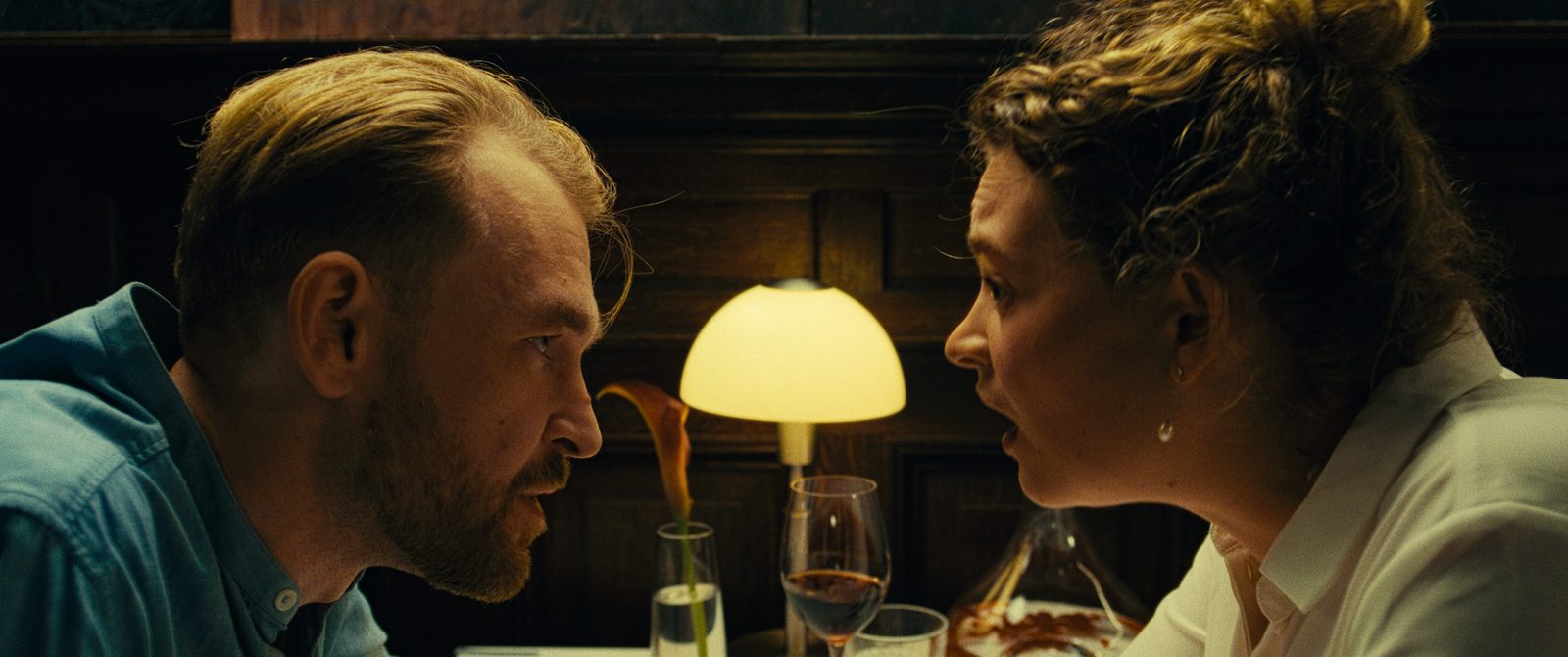
But the idea on its own started when I was working on a previous film, when I was talking to my producer in a café in the middle of Amsterdam, and I saw a bartender in only silhouette because the bar was lit up behind him. I thought, “this would be a cool shot to make a film with”. But I didn’t know the story. It could be a slice-of-life film, which I like, but for a very short film it could end up being forgettable. We were like, “we need to spice it up a bit.”
It felt very much like the opening of Pulp Fiction. The next step was thinking, “what if there’s a bag and you cannot really tell what’s in it?”. And from there we started working on the script and moulding it.
(On the subject of filming locations.)
The first idea was to do it in a skyline restaurant. We thought it would be easy, but it was around the time of Covid, and a lot of restaurants were closed. The biggest things when you’re making a movie are: find money and then find a good location where you can shoot for free.
James: I think you found a good location. It’s very immersive.
Bastiaan: We got to shoot there for free and we went there and thought “this is fantastic”. It has the whole atmosphere; you don’t have to do much production design. It was such luck we found that place. It changed the whole look of the film from when we were in our other location – changed all for the best.
James: In terms of genre, you manage to effectively combine a relationship narrative – what feels like a realistic, talky drama – with something leaning into psychological horror. Do you enjoy playing with genre and audience expectations?
Bastiaan: Yeah, I think so. It’s also what I look to for horror movies right now. If you take the film Weapons, if you remove the genre part — the horror part — it’s a very good drama film on its own. There’s a lot in that movie where you go away from the horror part for a long time, and still, it’s a good film. I really like that, because I’d been critical a long time ago of films that were just scaring and had empty characters. It has to stand on its own and pick up the drama.
You need to care, and in a short film you need them to care in a very short time. It’s not only just to scare people with jump scares; those are fun, but I also want to make an impact. I wanted people to care about it. In the past, I think people are mostly only drawn to the entity in the film and not focused on the character. If you make a film, make sure people care about the characters, and it should work without the horror element. And that’s what I tried to do.
All the films I make now are totally different from each other, but they all have this dark silver-lining. They all have this dark “there’s no hope” (feeling), but we (the audience) still want to think about it.
James: What were some of your influences when making this? Did you spend much time looking at other movies for inspiration?
Bastiaan: For this film, I don’t know. I started watching certain one-shot films – there's a German film called Victoria, a one single shot film for two hours without cheating and it’s great. It doesn’t look like my film, but I would like to see how those films work. I got influenced by so many different films. For my first film, On Air, I was very influenced by Talk Radio, I saw at the time Drive, and I liked the style, so everything is bits and pieces of homage to other filmmakers – but I think it works for everyone like that.
It started with Nicholas Winding Refn. Also, a film I watched a lot of times was the film Possession.
James: Very good film.
Bastiaan: It’s sad to see about Sam Neil.
James: I know. And he’s amazing in that movie.
Bastiaan: Yeah, he’s fantastic. But yes, I’m influenced by so many filmmakers and Nicholas Winding Refn is one of them – but he also has some films I don’t like.
James: I wouldn’t have thought that necessarily watching your film, but thinking about it maybe I can see some little stylistic traits.
Bastiaan: Have you ever seen the Pusher trilogy?
James: I’ve not seen the Pusher trilogy, no.
Bastiaan: It’s funny how his style changes; how he made films in Denmark and then in America. Because in Denmark everything looked so raw, and now everything is so neon and super stylistic – it's so different.
James: You managed to get two incredibly powerful performances from your two leads. Have you always been comfortable directing actors?
Bastiaan: I started out acting because I wanted to be an actor, but I found out I wasn’t very good of an actor. So, I started to make films and thought, this is something I like more — but I know what I want from actors. I talk a lot with them and I’m very confident that I know what I want from them. For the guy who played the boyfriend, he’s a friend of mine so he knows how my brain works. That’s very easy. Actors are fine, but they’re too busy with what’s on the paper and stick to what the script is. But I said that if you say a sentence a bit differently — what feels natural for that character — it doesn’t matter if you miss out a certain word.
James: This being a one-shot film, how did that impact how you were directing the actors?
Bastiaan: You can’t really stop every take if the line’s wrong, so you have to rehearse a lot. I was happy when we found the location, but this was the next challenge. We rehearsed on three separate dates. I just wanted to say as much as I (could) beforehand because during shooting we don’t have much time to discuss everything because we have to do everything in one take — and in one day because there is no money.
(On the subject of limitations.)
With the location we had, we couldn't practice with all the equipment first. We had to decide on the spot how we were going to film it, the timing. Then we rehearsed and rehearsed and then we started to record. We only had four whole takes, and the one that was used was the final take. We had to do a lot in a very short time. If things weren’t perfect, it is was it is.
It was stressful, but I had a lot of trust in the people I worked with. You don’t want people who say Yes to everything, because you want to have a bit of pushback from your crew when they say, “actually, I think this is better.” I’m just an idiot with an idea; you want to find people who are very good at their jobs and passionate about the idea the way you are.
James: Do you have any projects you’re working on at the moment, or a new release on the horizon?
Bastiaan: I’m working on a new short film with the writer of ‘Heresy’. I’m working with that writer and also with the same actor as in ‘Amy & I’ and ‘On Air’. Hopefully we’re going to shoot it this year. It’s going to be a bit of a David Lynch, psychological horror film. It depends if we get a location and funding, but we have most of the team already.