The film, New York and Saxberger
Late Fame... It’s a very different story in a way. How did you feel about this?
Well, first of all, when they said, “Okay, we’re going to send you the script,” and I was sat in New York, my heart sank. I thought, oh man, another Hollywood cheat. They’re going to take a good property and ruin it, because Vienna was a huge part of this story and that kind of society. I couldn’t separate Vienna from some of the themes.
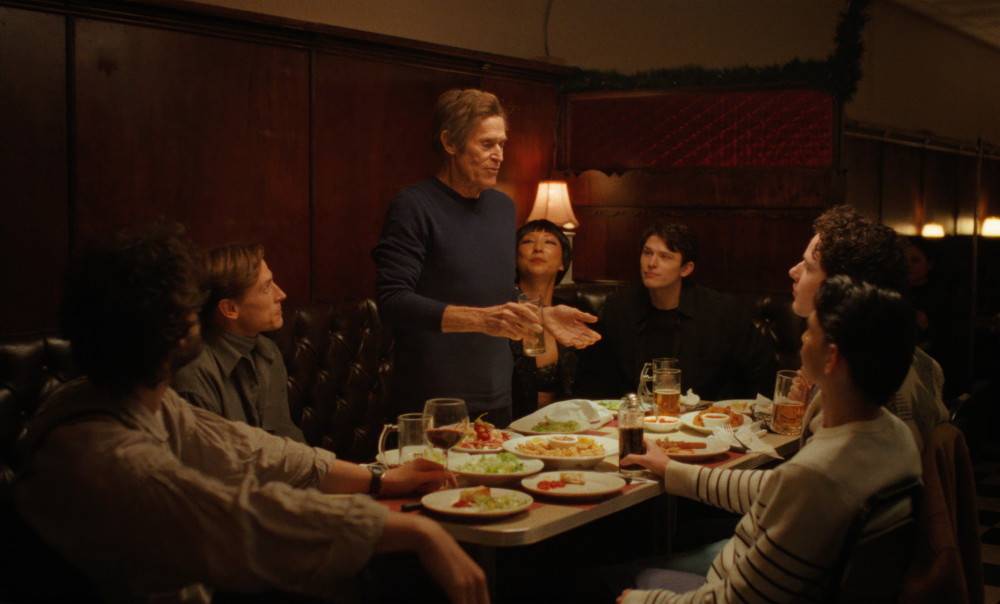
But then I read the Samy Burch script, and it spoke to me about things from when I was a young man in New York, this looking back at that time. When we were making the movie there was an interesting meta quality, because there were all these young actors just starting out. Unlike the guy in the movie, I’ve been working for a while, but I started in that period, when he was a poet. So I have very fond memories. Those were very formative times, very fertile times, not only for poetry but for almost all the arts. I’ve got a sentimental and a personal attachment to that.
And then to have these young actors who are starting out now, who have been to good schools, who don’t know much more about the business than I did, or even do now. They’re much smarter, much more capable, but they want to know about those days. In the actual making of it I found myself getting sucked into telling war stories, playing the old actor. I don’t think of myself that way, but next to them, that’s what happens.
So there are lots of parallels in making it with some of the themes in the movie, and that’s always interesting, because it gives it a context. You don’t even have to personalise it, because it’s all there. That’s what makes your experience authentic: you have skin in the game. You’ve got an imagination, and I know what that seduction is, people telling you who they think you are, sometimes out of flattery, and out of liking the attention you go towards that. We all deal with that in various ways in our lives when people flatter you. We don’t want to disappoint them. We want to be the people they want us to be. And that’s interesting to me.
That’s one of the things that struck me. It feels like a departure for you as a character. A lot of your roles are quite full-blooded, well-defined, strong characters, and Saxberger is a reactive individual, isn’t he? He’s shaping himself into what the boys want him to be. How did you approach that?
No, it’s really true. He is a reactive character, so he’s being acted upon. Really, you try to take it on, and it’s the old question: what would I do? And, like I said, I had some contact with it, so I didn’t break a sweat trying to do that. It was really just take it easy.
Also, you’re dealing with New York. I still keep a place there, but I don’t really live there anymore. But my whole adult identity is with New York, so I felt comfortable. It’s not often that I do a role where I say, if my life was different, I could be this guy. It’s happened a couple of times. I can think of a movie like Light Sleeper. He was a white-collar drug dealer. I’ve never done that, but I could have been. There are a couple of other movies where you feel it’s close to you, you could have been this guy.
I felt that with this, particularly since there’s all sorts of reflection about age and getting older, and being attracted to a younger energy. I’m experiencing that now, because in my head I don’t think of myself as my age, but what gets reflected back to me a lot is, I’m an old dude now. That’s not my identity. I’ve never thought of myself that way, and I still don’t. So you struggle with who you really are, and what’s delusional, what is to be encouraged, what is to be fought, what is to be let go. All of that is in the mix.
It’s a small film, we shot it very quickly, and it’s on a very humble budget. But it means a great deal to me, because there’s real contact there for me personally.
I read an interview with Kent Jones, who said that both you and he felt there was more warmth in Samy Burch’s screenplay than in the book. I read the book, and I would agree, certainly in the case of the Greta Lee character, who is treated more kindly in the film than in the book. Can we talk about Gloria? It feels like Saxberger is the only person who can really see beyond the performance she’s putting on.
What’s interesting about Gloria’s character for me is that she’s at the point where she’s going to decide whether to continue with these aspirations or do something else. And he had that moment somewhere in his past. So there’s a flirtation, but he also recognizes her ambition and her desire to live an artist’s life. She hasn’t really found success, and she may move on to something else. So she’s a reminder of maybe where he once was. It’s open enough that it can be whatever you want.
Working without discussion

What kind of conversations did you have with Greta about the scenes you had together?
No conversation. Nothing at all. You don’t need it when the world is complete and the situations are clear. I didn’t talk with Greta or read about anything. We just did it. That’s often the case, I find.
I don’t want to be glib at all, because there are all kinds of ways to work, and it’s a very collaborative thing. But when you don’t work in the movies, you always hear these stories. The classic one, for me, is Martin Scorsese with Robert De Niro doing 100 takes on New York, New York, and having a conference before every take. I’ve never experienced that. Even with Martin Scorsese it was all doing, doing, doing. It’s about recognizing the world, being on the same page, and then proceeding with the actions. This kind of discussion about things doesn’t happen as much as you’d think.
Even with someone like Lars von Trier? No discussion? Really?
No. Lars is all about shooting. He’s the guy that says, “You only need one.” He doesn’t even craft coverage or anything like that. He gets in the situation and shoots away. You don’t know where the camera is. He’s a writer, but he encourages you to play around with his words if you feel more comfortable. Sometimes he’ll just let it roll. You’ll finish the scene as written and he’ll keep on shooting, and he doesn’t tell you that.
He’s very particular, but he talks very little. He does steer you in certain things, and I’ve worked with him several times. In a movie like Antichrist, I played a therapist who does a particular kind of therapy, and he set me up with research to go and study with these guys for a while. So there’s preparation, don’t get me wrong. But when you’re there, there’s none of this “I think you need a little more here.” It’s much louder, faster, looser, tighter than you think.
Maybe you’re just really good.
I don’t know. I try to work with good people.
Range, fear and letting go
I always admire how wide-ranging and diverse your career is. It’s a really extensive body of work, and you move from small gambles with unknown directors to much more established people, and Hollywood projects too. Is there a method behind it? Is there a plan, or do you seek stuff out?
A little bit. I’m not a careerist. I’ve always wanted good opportunities, but I’m always trying to trick myself into having a different job. Acting is not one thing. It’s not something you just apply. You go to the project and you have to figure out what your job is. Some projects are very small and shoot very fast. Others have lots of resources, lots of time to shoot, lots of help. The little ones are scrappy as hell and they just flow. The job is different each time.
So, in order not to get flabby, and not to get lazy or complacent, you give yourself healthy challenges, and that comes from mixing it up. You also want to deal with different points of view, because one of the pleasures of being an actor is that you get to think in different ways. You take someone else’s point of view, a different view of life, and sit in it for a little while and imagine a different life.
So you’re seeking not just adventure but challenges to your way of thinking and doing things. When you do that and survive it, it gives you more space. It gives you a bigger heart, a bigger mind. Then you’re more flexible. Once you’re receptive, flexible and tolerant, you can beat fear a little better, and things can’t oppress you. You can do the best you can, and that’s good enough if you feel clear and you’re not afraid.
All actors will tell you they’re a little afraid when they start. The beauty is, if you do this for many years, you realize you survive that fear. The fear doesn’t go away, but you say, “Oh, I recognize this,” and rather than pushing it away and squelching it, you invite it in. “Come on, work on me. See what you’ve got.” It may kill you. You may fail, you may make a bad movie. But you’ll never make a lazy movie, or a movie where you walk through something. Not because, morally, I think that’s bad. It’s just not fun. You don’t feel engaged, you don’t feel in the groove, you don’t disappear into something that makes you part of a bigger picture. And that’s always what’s fun to do.
Given that you really engage and disappear into characters, how easy is it to shed them and let go at the end of a project?

The characters come out of the actions, and the actions come out of the situation. When the situation goes away, the character goes away. It goes back to where it came from. You can encourage yourself to hang on to it, but I don’t recommend that, even with a nice one. You’ve got to let it go and make room for the next thing.
It won’t leave you, I mean. The things I learned, I learned intuitively, and they’ll be with me forever, like a very good or a very bad love story. It stays with you. You don’t have to hang on to it. So make room for the next thing. Love the one you’re with.
What he hasn’t tried, and directors with a complete world
It’s possibly a silly question for someone with over 150 films to his credit, but is there anything you haven’t done as an actor that you’d like to do more of, or haven’t ever tried?
I’m sure there are many things I haven’t done. I intend to do them, but I don’t know what they are. If you set yourself up, there’s an expectation, or a hardened idea of what you’re going to get from the experience. That’s why you’ve got to trick yourself into feeling like you’re doing it for someone else, and why it’s so nice to have a strong director, because then it’s very clear. We all thrive when we feel useful. If a director sees something, the job is to make that manifest. Use yourself like material.
That also helps you get away from thinking it’s about you, or that it’s limited by your skills, your intelligence, your cleverness, your ability to mimic, do accents or do physical things. That’s out the window. What is done is what is needed. And you get help. Even in a very small movie like this, even if a director doesn’t talk to you, even if you’re shooting very fast, it’s a team effort. And the world, if it’s well made, will tell you what to do. You naturally melt into that world, because you want to.
There are a few directors you’ve worked with repeatedly: Lars von Trier, Wes Anderson, Robert Eggers, Abel Ferrara. What you just said about the complete world: I’d say those are directors with that kind of overarching vision. Is that what draws you?
You got it. A perfect example, well, they’re all examples, but I also thought of David Lynch. The world he makes is so clear that when you enter it, you know what has to be done. If that sounds easy, it isn’t, because it’s about managing that engagement. Once you know what has to be done, it’s how elegantly, openly and receptively you do it. They give you everything, because the story is told by what’s around you.
That’s one reason I like Robert Eggers so much. When I first saw The Witch, I thought, I can enter this world so easily. A lot of period films are always telling you, “This is a period film. Look at this thing, it’s from old times. Look at this dress.” I don’t feel that with him. He makes the world, everything has a reason, and when you enter it, you’re part of that reason.
People think it’s about choices and creating things. Yes, but it’s all about actions. I wouldn’t even say it’s about telling stories. Making anything is really about bringing stuff into a space and ordering it in a way that it wasn’t ordered before. That’s how you make a world, and then the actor’s role is to live in that world.
Enthusiasm
We’re running out of time, but maybe one more question. The Enthusiasm Society is patently ridiculous, because they’re enthusiastic about the idea of enthusiasm. But watching the film, it occurred to me that enthusiasm right now actually feels quite pure and positive. What sparks your enthusiasm? It doesn’t have to be film-related. What makes you feel engaged and enthusiastic?
The feeling where you give yourself to an action and lose yourself in it. You lose all your worries and everything’s perfect. If things flow in a certain way, you fall into line with what is. So you’re always reaching toward that somehow.
Performing is all kinds of things. It can be silly, it can be showy, it can be vulgar, it can be ridiculous, it can be heartfelt. But when it comes down to it, when you lose yourself, you don’t really lose yourself. You gain everything else. I don’t want to get too crazy Eastern on all this, but it’s the drop of water becoming the ocean. I’ve felt that sometimes. Everybody feels it sometimes, when they do things they love, or when they’re in love, or doing things of great pleasure. You become everything.
That kind of engagement is what you try to replicate when you’re performing. You’re not doing it for acceptance, or even to do a good job or be a good actor. It goes beyond that. That’s all bullshit. You just want to be there and have it happen. That’s what I keep coming back to.
Paint the light

You have such a huge body of work, and it’s hard to pick one thing out, but are there certain moments, certain films, that changed the course of your life or career?
Many. Each film changes you. I look at my life and remember it by different plays and different films. But the one that really changed me, and it’s fairly recent, was playing Vincent van Gogh in At Eternity’s Gate. It had a lot to do with learning how to paint.
What I keep returning to, not a revelation but a kind of guide, is this. Julian Schnabel, who is a painter and directed that film, said to me when I was painting a tree, “Don’t paint the tree. Paint the light.” That was such a big deal. When you get practised at it, it’s a different way of looking at things. Rather than seeing things as pure function, you start to see their origin and what they’re made of. You see the elements, where they’re coming from and where they’re going. It puts you in the feeling I’m always trying to reach.
When I’m looking at you right now, if I go straight to function, to the practical thing, that closes down a lot of possibilities about how I see you and how I see this moment. So I think that was a profound thing. I’m not sure I’m articulate about it, but maybe you have a little taste.