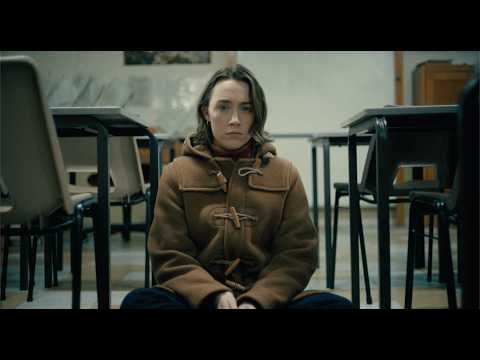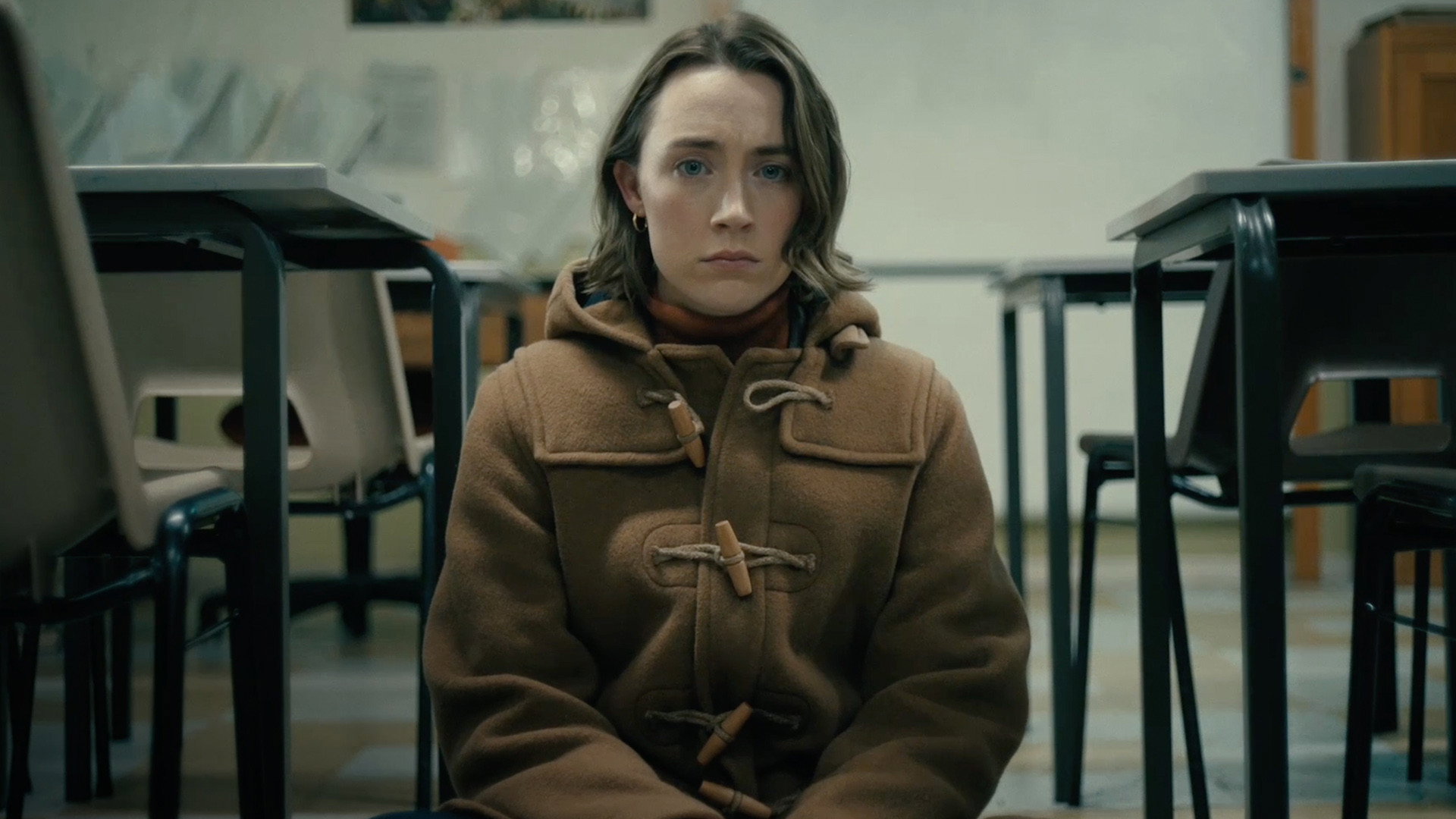
For years, Saoirse Ronan has worked almost in the background of Hollywood. She may not be present all the time, unlike what seems to be the trend with today’s greats — Robert Pattinson, Zendaya, Anne Hathaway — though when you see her name on the callsheet, you know she won’t miss. No matter the script, no matter the story, Saoirse Ronan always manages to stay consistent in her own work. She has a talent to play any script the same, in a way, no matter the quality, making any movie she appears in infinitely better for it. Bad Apples is no outlier, and is dependent on that fact, due to much of the heavy lifting being done by Ronan herself.
Over the past few years, we’ve seen Saoirse Ronan continue to carve out a particular niche for herself, and it’s one that she seems to greatly excel at: a regular woman on the brink of a new era. It’s fortunate that this is quite a vague niche, as it allows one of the greatest and — at least in my humble opinion — most underappreciated actresses of our generation to avoid any kind of typecast. She may not become unrecognisable, but Saoirse Ronan disappears into every single one of her characters, making it somehow impossible for her to fall into the ‘movie star’ trap that seems to be getting more and more prevalent in recent years.
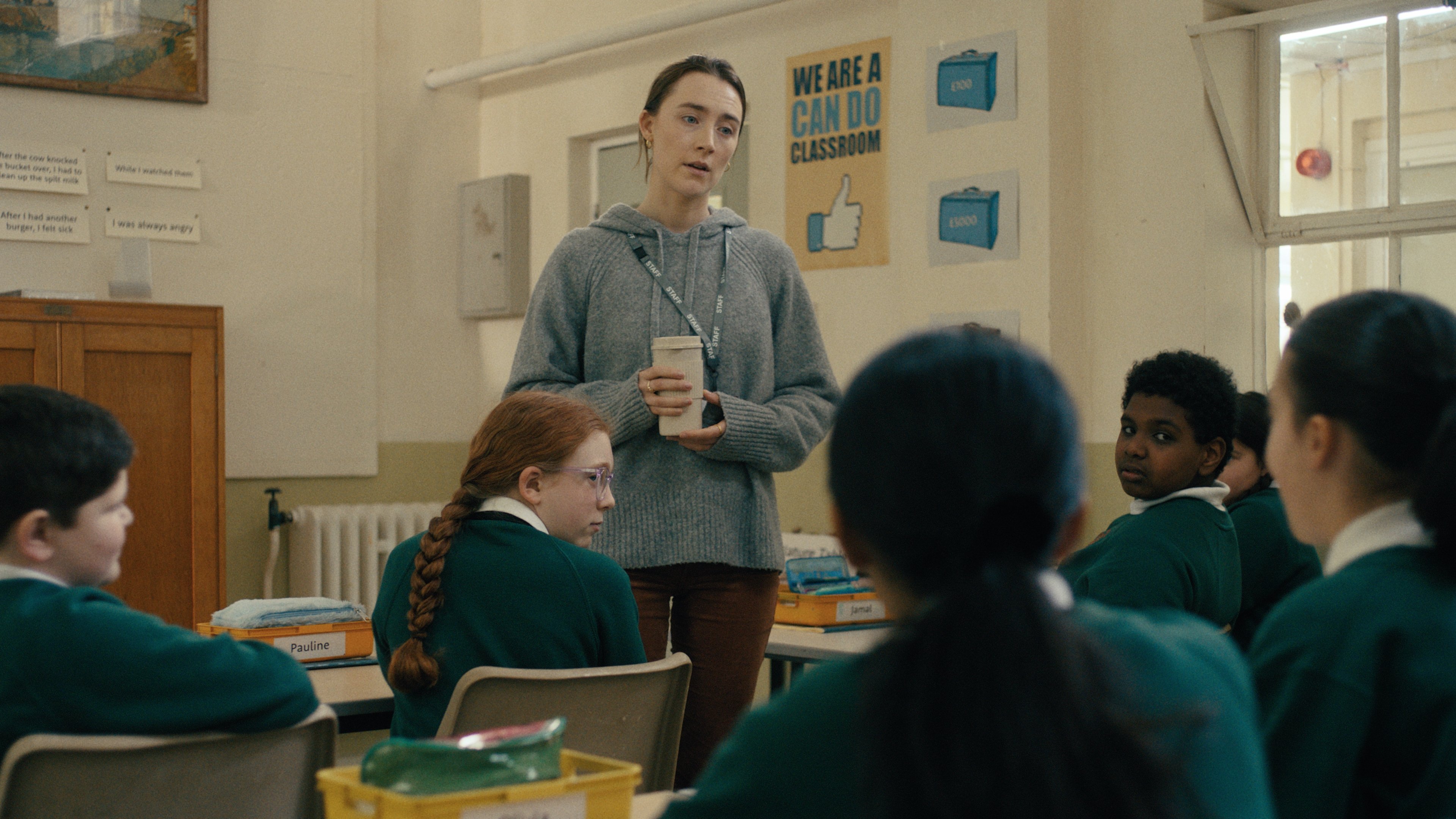
Bad Apples meets us in a primary school. We see a few days of normality in this world, led by Ronan’s Maria, with one disrupting child. We see how Danny’s outbursts affect the classroom environment, as well as Maria’s teaching, which all feels very mundane, though in a good way. Director Jonatan Etzler takes inspiration from the 1968 Swedish drama Who Saw Him Die? to put the focus on the breaking down of Maria’s psyche more than her relationship with her class, laying an incredible foundation for the rest of this feature.
However, this seems to act as almost a sequel to Who Saw Him Die? as it starts around the end of this journey, foregoing almost all that led us to this point. Simply, I would have liked to have seen more at the start — before the kidnapping. This would have hugely benefitted from a few scenes that developed how Danny affects the workings of the classroom, Maria’s mind, and the other children. On the surface, this seems like a heavy task, though I feel as if they simply could have done more of the same. We were already working towards this, just not quite as much as we should have. The entire story relies on this opening, so why not make sure it sets the proper groundwork, no matter the runtime?
Throughout this movie, we follow Maria as she unwillingly nurtures a much more personal life with two of her students, Danny — the troubled child — and Pauline — the favourite, according to her. Danny is the obvious focal point and shows the effect that a misbehaving child can have on the rest of the class. However, something more interesting, to me, was how they showed who Danny really is. He isn’t simply a ticking time bomb, waiting for somebody to simply look at him wrong before blowing up entirely. Behind everything, all his antics and borderline criminal activity, Danny is still just a child — a neglected one at that. We go from absolutely despising this kid to sympathising with his home life. Is it really his fault that he acts this way? Would it be different if his home environment was more nurturing?
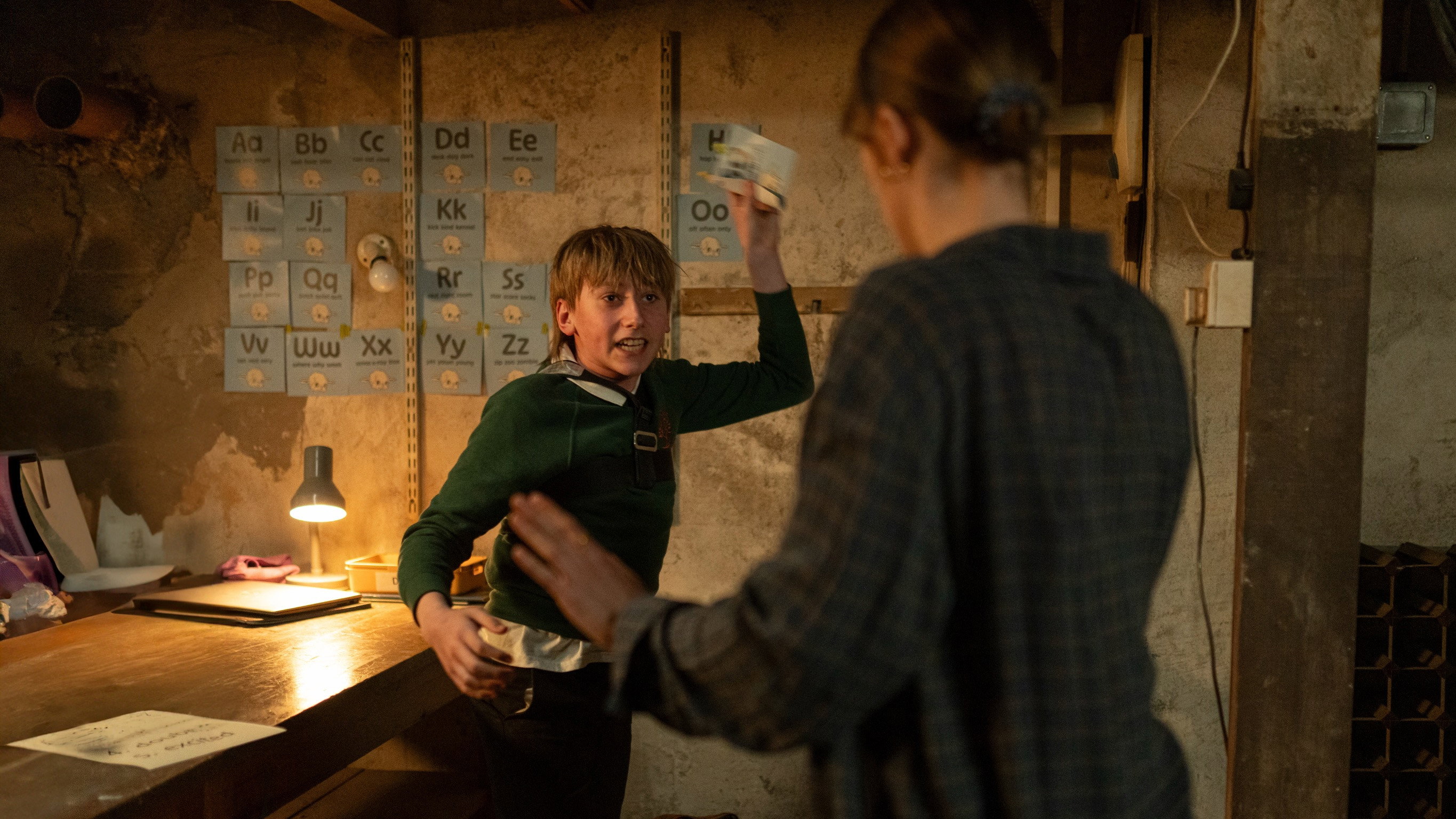
Even though Maria is the main character of this story, we’re shown such a detailed character study on Danny, as well as misbehaving children in general. We see how a home and school life that antagonises Danny simply digs him further into this hole, until it seems there’s no way out.
Pauline, at least her involvement in this story — is introduced much later, though shows quite an interesting layer to this. While Danny becomes the teacher’s literal pet, Pauline is much more of a metaphorical one. We see how Pauline creates somewhat of a parasocial relationship with her teacher, though all she requires is an adult who pays attention to her. Her finding Danny, and subsequently joining his one-on-one lessons displays Danny’s fragility. As soon as he’s confronted with just how far behind he is, compared to the rest of the children, he once again begins to lash out and handle these emotions in the only way he’s learnt is effective — violence.
In the third act, we’re asked an incredibly interesting and equally layered moral question — one that the movie finds its own answer to, though it doesn’t tell you what yours should be. Is it okay for Danny to be in this situation, in the best interest of the rest of his class? This is essentially the ‘Trolley Problem’, sacrificing the few to save the many. The whole movie leads up to this point, as we see everybody else — including Maria — thrive with the disappearance of Danny, so is the suffering of one justified if it benefits the many? I won’t answer this for you, though I urge you to ponder it yourself after leaving the cinema.
Even though this entire movie works towards this final moral quandary, the midpoint somewhat drops off and becomes very little more than filler. Until Pauline eventually finds Danny, jumpstarting this movie once again, it consists of a lot of the same. Maria keeps Danny in her basement, lives a normal life, and tries to justify her situation by making Danny’s life marginally better — framing it as nothing more than a few one-on-one sessions, helping him improve.
This isn’t bad filler, the writing never dips, but it’s still filler. I can’t imagine, a week or two from now, I’m really going to remember much of what the middle thirty minutes is full of — there’s a reason I’ve only really spoken about the start and the end thus far. The middle of this is simply just quite boring and makes this hundred minute movie occasionally feel far longer.
While Bad Apples doesn’t always manage to hold my full attention, it does something arguably better — it made me think about the movie all the way home. In a few weeks, I may not remember half of this, but I’ll remember how it made me feel afterwards and what it forced me to ponder. The only thing perfect about this, really, was Saoirse Ronan, a woman who seems to never falter, but that’s fine because nothing ever became outright bad — despite what the name may suggest.