Moses said, “Please show me your glory.” And he said, “I will make all my goodness pass before you and will proclaim before you my name ‘The Lord.’ And I will be gracious to whom I will be gracious, and will show mercy on whom I will show mercy. But,” he said, “you cannot see my face, for man shall not see me and live.” Exodus 33:20
Our first contact with Portrait of God is the warning of Exodus 33:20, where God forbids Moses from looking upon His face. This terrifying warning frames the opening of Dylan Clark’s seven-minute short film, introducing us to Mia as she rehearses a presentation. She stands before a slideshow, sharing a picture of a painting that is supposed to be an image of God. What we see along with her, however, is only a black canvas. She goes on to explain that while most see the empty void, a few claim to see the figure of a man, with every single description matching.
As she rehearses, her facial expressions reveal some sort of discontent, a quiet longing. Fiddling with her cross necklace, she seems to betray an immense desire to join that group of witnesses. Maybe she wonders why God has given the sight of Him to them but not to her. Perhaps she doubts those testimonies. She could be skeptical, like Doubting Thomas was when told of the resurrection of Jesus, the OG “I'll believe it when I see it.”
The atmosphere of the movie begins to change as she stops again to stare at the black canvas. Slowly, she starts to see a soft outline that transforms into a distorted figure. First, she smiles, relieved she sees something. Then the scene culminates in Mia growing so scared she tries to flee from the classroom, except she can't. She falls directly into a black void and stands face-to-face with that ominous figure. Her object of longing is now what scares her so deeply.
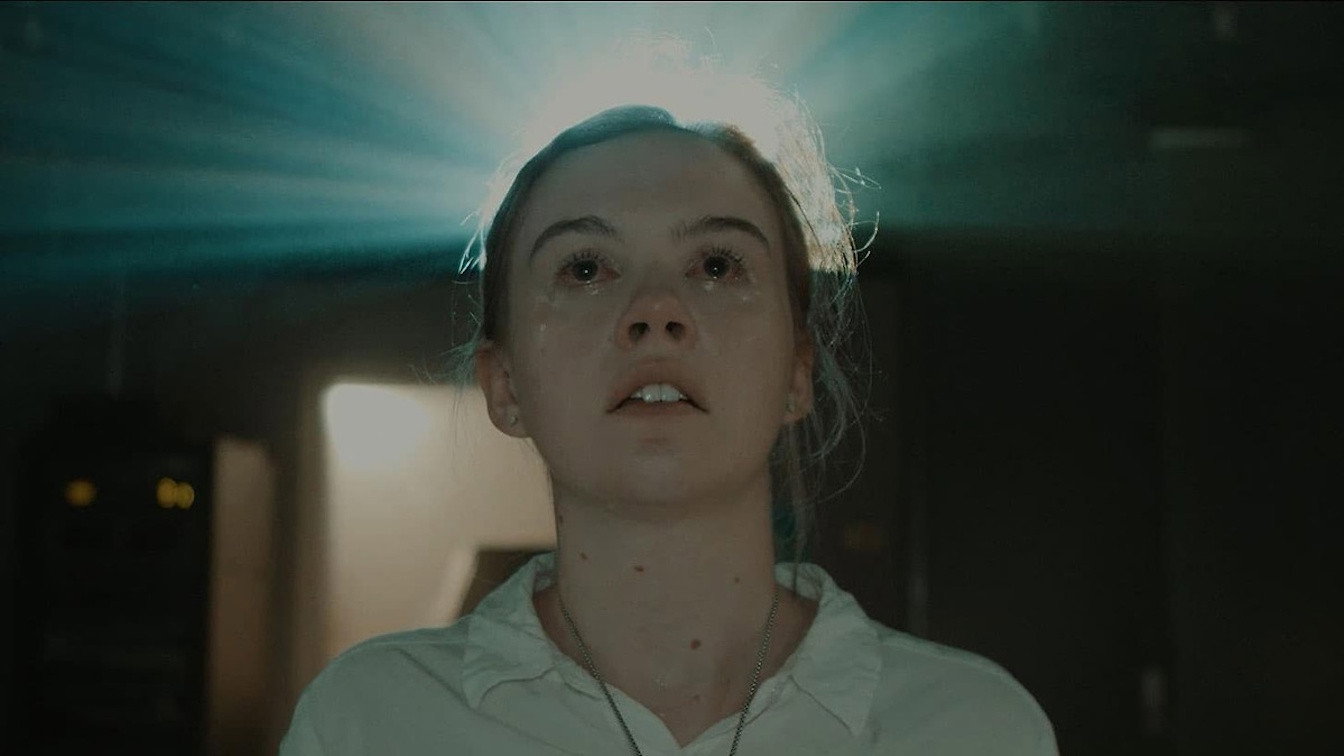
Inside that void, two eyes glint back at her in the dark. She again grips her cross and begins praying the Lord's Prayer, turning her face away from where the figure approaches. A hand seizes her chin and turns it to Him. When she finally opens her eyes, her fear gives way to awe. We see a shining light coming out of his mouth that reflects upon Mia's eyes. It seems like we're witnessing a moment of enlightening, a dream coming true. But the film cuts abruptly, and we realize she was still in the classroom, paralysed. Her eyes are red, and her face isn't awed the way it was inside the void.
There is a deep ambivalence in how believers and society in general interact with the divine unknown. While Christianity frames God as a loving, compassionate father, it simultaneously builds its foundation on the "fear of the Lord." This duality is present even in the vocabulary we inherit.
I was raised a Catholic, studying in Catholic school alongside nuns my whole life. One day in catechism, we learned about that exact same saying, but in Portuguese: “Temor a Deus.” None of us kids had ever heard the word temor before; in Portuguese, our everyday word for fear is simply “medo.” The teacher explained that temor meant “to respect God so much that we fear him. Just like how it should be with our parents." Oh, okay weirdo. Would God's version of grounding be sending us to hell?
I hated the idea of having to fear God. I didn't want to fear the one that was supposed to love me unconditionally. At home, without the nuns hearing, I was taught that the easiest place to find God was within ourselves, and not necessarily inside a church. That He was as close to me as He was to the priest. Even as I grew older and left the religion behind, I still couldn't get over that saying. So I decided to investigate.
Diving into the meaning of temor, we discover the same ambivalence society faces in its relationship with God. It means an awe so tremendous it turns into fear. Fear that is born out of extreme devotion. A love so intense that it turns the loved object into something unquestionable. I don't know about you, but to me it sounds as compelling as a gothic romance plot. The language makes this ancient text feel personal, yet serves as a reminder that God can't be brought too close to humanity. Scripture treats His image as an impossibility, making any attempt to depict or worship a physical form strictly prohibited. He had to remain an unreachable taboo.
Originally a Polynesian word, taboo also carries huge ambivalence within its meaning: it's both the sacred and the dangerous, the consecrated yet the unclean. To translate this ancient concept for the modern world, Sigmund Freud came up with a distinct pairing of words: “holy dread.” Such a beautiful way of putting it. It is, in my opinion, the most fitting description for our protagonist's situation. A frozen state of holy dread.
When we reach the ending of Portrait of God, we get to what is probably my favourite scene: Mia with this very unsettling look on her face, bleeding because of how tightly she's gripping her cross necklace. Sydney Brumfield gives an incredible performance here. Awe, inside the void, is easy to feel. What she does is play the after: an expression closer to shock that hasn't caught up to itself yet. It cannot be easily described, and that's exactly the point.
The first thing that came to my mind was how she bleeds from a cross, paralleling Jesus: both of them bleeding because of their intense devotion to God. As the Bible tells it, Jesus willingly accepts to sacrifice himself to save humanity. Mia, as she sees what we believe to be God's face, bleeds on a cross as well. Does she cling to it as a way of seeking His protection? Or does she bleed from wanting to see His face so much, ultimately breaking a law imposed by Him? Whatever the reason, the blood marks the object, turning it into something more.
This reminded me of Sofia Coppola’s The Virgin Suicides, where Cecilia keeps a devotional card of the Virgin Mary that eventually appears stained with drops of blood. I was given a little card just like that, with the Virgin image and a prayer dedicated to her, by my mom. I've never been one for prayers, yet that card lives in my bag like an amulet, guarding me. My attachment to it has nothing to do with religion, and everything to do with the relationship etched onto that piece of paper. We carry our earliest relationships forward in whatever we end up worshiping.
Perhaps Cecilia, like Mia, was reaching for something sacred to hold onto. Everyone has the ability, and dare I say the necessity, to have something that feels holy. We yearn for that magical, otherworldly meaning, which brings us right back to the reality of Portrait of God. Clark's protagonist holds her cross necklace throughout the whole film. She fiddles with it and caresses it like an automatic movement, a physical thread tying her earthly body to a celestial yearning.
Mia possesses the exact same ancient desire that drove Moses: she wants to see the face of what she believes in, her divine love. The film seems to leave us with two possible endings: Mia leaving that room terrified by the entity she is devoted to, or leaving with her faith forever fortified.
But the truth points to a third option. To feel devotion toward something requires absolute idealization, and Portrait of God shows what happens when we face our most idealized object. Fear or fortified faith were never really two separate paths. To face the truth of idealization is mesmerizing as much as it is terrifying, and that's why this film excels so much in showing that duality throughout those seven minutes.
Coming face-to-face with an idealized love is heartbreaking because it is decisive: it changes what the relationship becomes from that point on. And whether the figure in the void is truly God or not stops mattering, because idealized love is never what we envisioned it to be. The object was never real: the devotion was. The collision between the idea of the thing and the thing itself is where Mia is left standing. Not fortified, not broken, but suspended. Her third way is the way of holy dread.