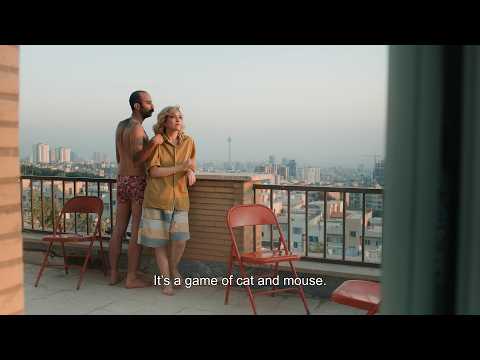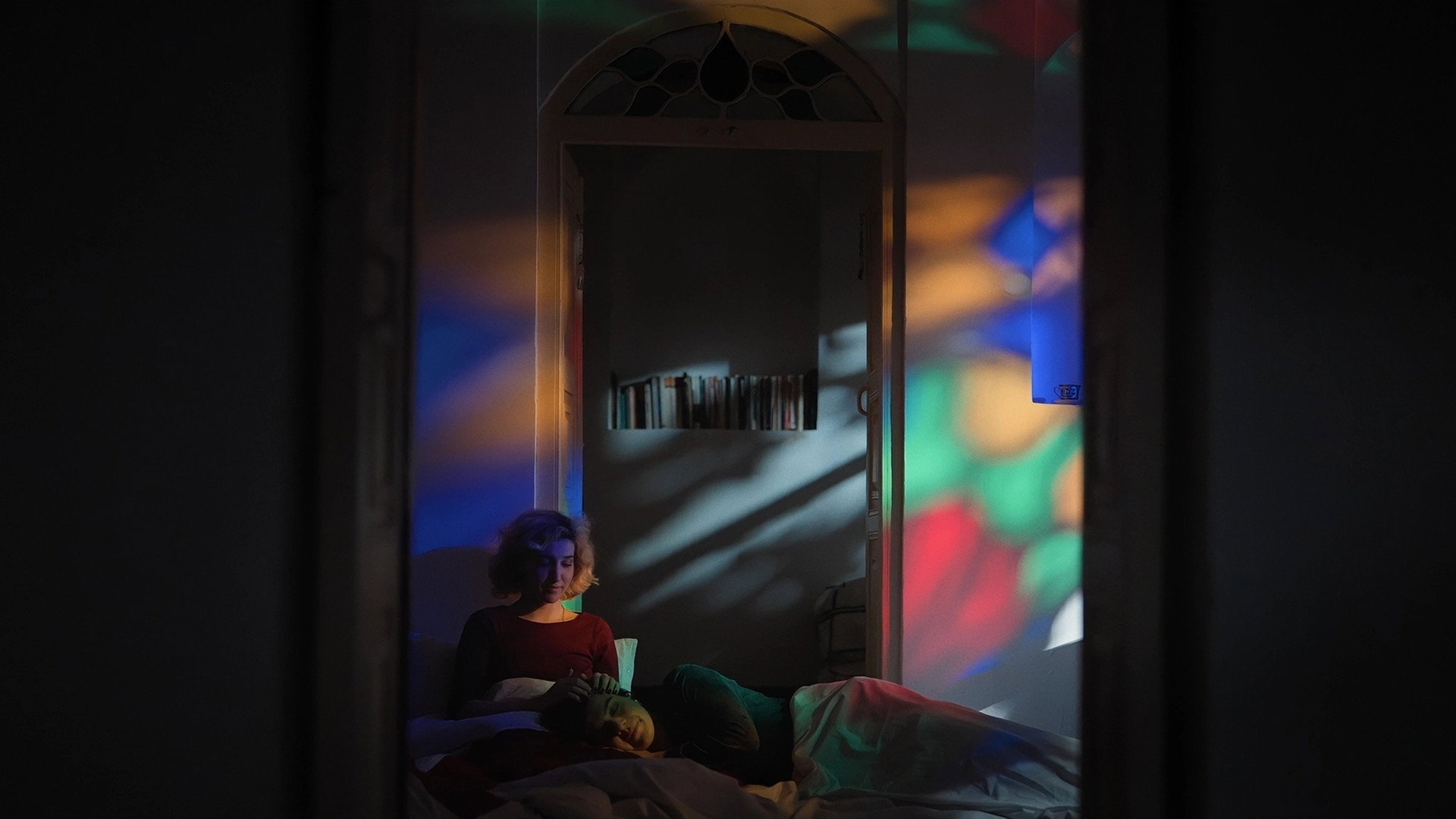
Written and directed by Hossein Keshavarz and Maryam Ataei, The Friend's House Is Here follows Pari, a playwright, and Hanna, a dancer, two best friends living within Tehran's underground artistic community. Through their friendship, their performances and their everyday lives, the film explores what it means to continue creating art while resisting the restrictions imposed on them.
The way the film is shot tells us what our place is: we're spectators, yes, but we also feel as though we're inside it, almost as if we're little birds, getting to watch people living their lives. The scenes unfold in uninterrupted takes, with different things happening at once, giving the audience the freedom to choose where to look.
In one scene, the camera is positioned in the middle of a group of people, their bodies partially blocking our view. As they move around, we catch glimpses of a conversation unfolding in the background. I caught myself leaning to the side or even forwards, as though I might somehow be able to see past them and get a better look at what was happening.
During LFF, I spoke with co-director Hossein Keshavarz about the film's cinematography, the difficulties of making art in Iran, the representation of Iranian lives on screen, and why friendship and community lie at the heart of the story.
Eloísa: Why did you decide to let the audience discover for themselves what they should pay attention to?
Hossein: For a couple of reasons. We were inspired by this underground improv theater group that we got to know. And so we would see a lot of plays that they would put on, and it would be so amazing, and it would just be of that moment. And it would pass. That was the only time you could ever see it.
We were also inspired by the long takes in Iranian cinema. There is a whole tradition of that. But at the same time, we didn't wanna make a film that was too stuffy or too laborious or boring... especially because these young kids are so fun and exciting. So we were trying to figure out how we can marry that. The biggest thing is that we wanted the scene to unfold in the shot, something could be happening in the foreground or the background... having multiple planes of action. We wanted to have the audience kind of create a montage themselves. Then you take what you wanna take.
The Friend's House Is Here is haunting in a way you might not expect. Through scenes that are comedic at times, heartbreaking at others, Pari and Hanna stay with you long after the film ends. As do their dinner parties, their smoke breaks and their singing.
The political circumstances surrounding the characters often emerge in surprisingly understated ways. Sometimes, when a conversation suddenly turns to the war, you feel a little jolt, reminded of what's happening around them all along.
I think that's one of the most powerful things about the film: how it transports us into the characters' lives. This sense of subtlety is also present in the dialogue. At different moments in the film, I kept wondering how violence can get organised on the shelves of everyday life, finding its own spots, getting its own nicknames. Not necessarily disguised, but given a place in ordinary conversation. Perhaps so that people don't have to carry its full weight every time they speak of it.
When Pari's mother discusses her daughter's arrest, the English subtitles use the word “difficulty.” I asked Hossein whether living with fear for a long time might change the way we speak about frightening experiences, leading us to use softer words, or euphemisms, as a way of coping. I was also curious about the original Persian expression, and whether it carried the same meaning in English.
Hossein: That's actually one of the hard things to translate because she says hassās shodan, which means they [the government] become sensitive to you. Now they're paying attention to you, because you created a sensitivity. Basically, you're under the eye. And going back to the difficulty of making the film… In Iran, there is a vibrant artistic life. And they won't do anything to the majority of people until you create a problem for them.
When you create a problem for them, then they will go after you. So it's kind of that contradiction. People want everything to be black and white, but it's not like that. Every single day in Iran is like a pushback.
The film was shot in the aftermath of the June 2025 war, amid the constant threat of raids and arrests, leaving the entire crew extremely tense. But, like Pari, who continues making art even after her arrest, the filmmakers didn't give up either. Like veins running through a body, the film's story and the reality of its making are intertwined.
As Hossein explained, a filmmaker's home was raided just as production began, and another was raided when it ended. Shooting outdoors meant working as quickly and discreetly as possible to avoid attracting attention. And the difficulties didn't end when filming wrapped. During post-production, an internet shutdown left the filmmakers unable to transfer the film abroad. Crew members eventually carried a copy across the border on a hard drive, hidden among religious materials, so it could be completed in time for Sundance.
And yet, despite everything they faced while making the film, Hossein explained that they wanted to capture something beyond that.
Hossein: The thing we wanted to show is that there's a vitality in Iran. Especially with young people. There's so much fun and, and energy even though there's war. People's lives are not just what you see in the news. The news reduces that life. These artists, their lives are going on for years and will be going on for years after this, and they have a positive image of their lives. They wanna make their work, and we wanna celebrate that.
But at the same time, it’s challenging to show that. There's things put on them by the Iranian government. They've killed people in protests, there's censorship and everything. And then there’s things put on them by abroad, there's war and there's sanctions. So they're really being squeezed by both sides. Because in a way, the Iranian government and the American government actually wanna show the same thing.
They wanna show Islamic people like we're a different kind of nation than they are. Every country has its own history and culture, and Iranian’s is so beautiful. But you know, at the end of the day, we're very, very similar. But I think, especially for the Western media, it's easier to show them as the Other. And then when they're the Other, you can do whatever you want to do.
When I told Hossein how familiar Pari and Hanna's conversations and habits had felt to me – how much they reminded me of my own friendships, despite our different backgrounds – he returned to the question of how Iranian people are represented to audiences abroad.
He spoke about how films from Iran and other parts of the Middle East so often portray their characters primarily through suffering. While acknowledging the importance of those films, he admitted that constantly seeing people represented as victims can become tiring. He and Maryam had fallen in love with the people they were filming, and they wanted the audience to get to know them and feel that same affection. The political difficulties were still there, of course, but as Hossein put it, foregrounding them from the beginning could make the film feel like “homework.”
I kept thinking about Hossein's use of the word “Other.” It's easy to look at someone different from ourselves and see them as incomprehensible. And from there, it's a short step towards dehumanising them. Until we no longer feel their pain as deeply, telling ourselves, “Well, that's their reality.”
But by focusing on the girls' day-to-day lives, the film shows that, even from far away, we're not so different from them. Their lives aren't just headlines on the evening news or stories in a nonfiction book so far removed from our reality that our brains might as well treat them as fiction.
The mundanity of the film pushes us into skin-to-skin contact with their reality, making it harder to watch from a distance – and remain distant.
Beyond the importance of how these lives are represented, Hossein also spoke about wanting the film to leave audiences with a sense of possibility, especially at a time when feelings of exhaustion and hopelessness seem to reach far beyond Iran.
Hossein: One of the things is that we wanted the film to end in a positive message, empowering, because, listen: everyone in the crew and most of the actors had been arrested at some point, and they've continued on to do their work. Right? And we wanna show all those terrible things they had to go through, and criticize that.
But then we also wanna show they're continuing. And I think it's not just in Iran. It's a very difficult time in the world. People feel overwhelmed, they feel powerless, they feel hopeless. And I think in a way that's what the powers want us to feel.
Because if you feel overwhelmed, then you're not gonna take action. But we wanna say that we have agency if we're together. I think that community is such an important part of our culture. That's an important part of cultures around the globe.
And that sense of collective strength is beautifully explored in the film. Early on, we see Pari performing in her own play, searching desperately for her missing friend, Hanna. Outside the play, however, the roles are reversed.
Hanna, whom we've come to know as playful, carefree and sometimes forgetful, becomes completely focused on bringing Pari home the moment her friend is in danger. And she does it by bringing people together: friends, friends of friends, people from the town.
Thinking of this sense of community, I mentioned White Rabbit Red Rabbit, a play by Iranian playwright Nassim Soleimanpour that I'd seen earlier that week in London. Despite having been written years ago, the very nature of the play makes you feel as though Soleimanpour himself is speaking to you, right there in that theatre. Art can allow us to travel through time. It really can.
So I asked Hossein what he hoped The Friend's House Is Here would mean to someone watching it twenty years from now.
Hossein: You know, we were kind of taking inspiration from “Where Is The Friend's House?”, the Kiarostami film, which is also based on a famous poem in Iran. He was in dialogue with that poet, and we're in dialogue with this tradition of filmmaking. Which is basically this tradition of very humanistic filmmaking, which is people helping each other.
That's something that we really wanted to get across. This film is for this generation. People living in the city. Centering women's stories that haven't been seen. For us it's really important to have a story of friendship and community.
The Friend's House Is Here was selected for screenings at the BFI London Film Festival on 11 and 13 October 2026 and also won the U.S. Dramatic Special Jury Award for Ensemble Cast at this year's Sundance Film Festival.
The story ends with music and friends singing to each other. Reality hasn’t changed. Everything is still there. But they are celebrating their lives, one day at a time.