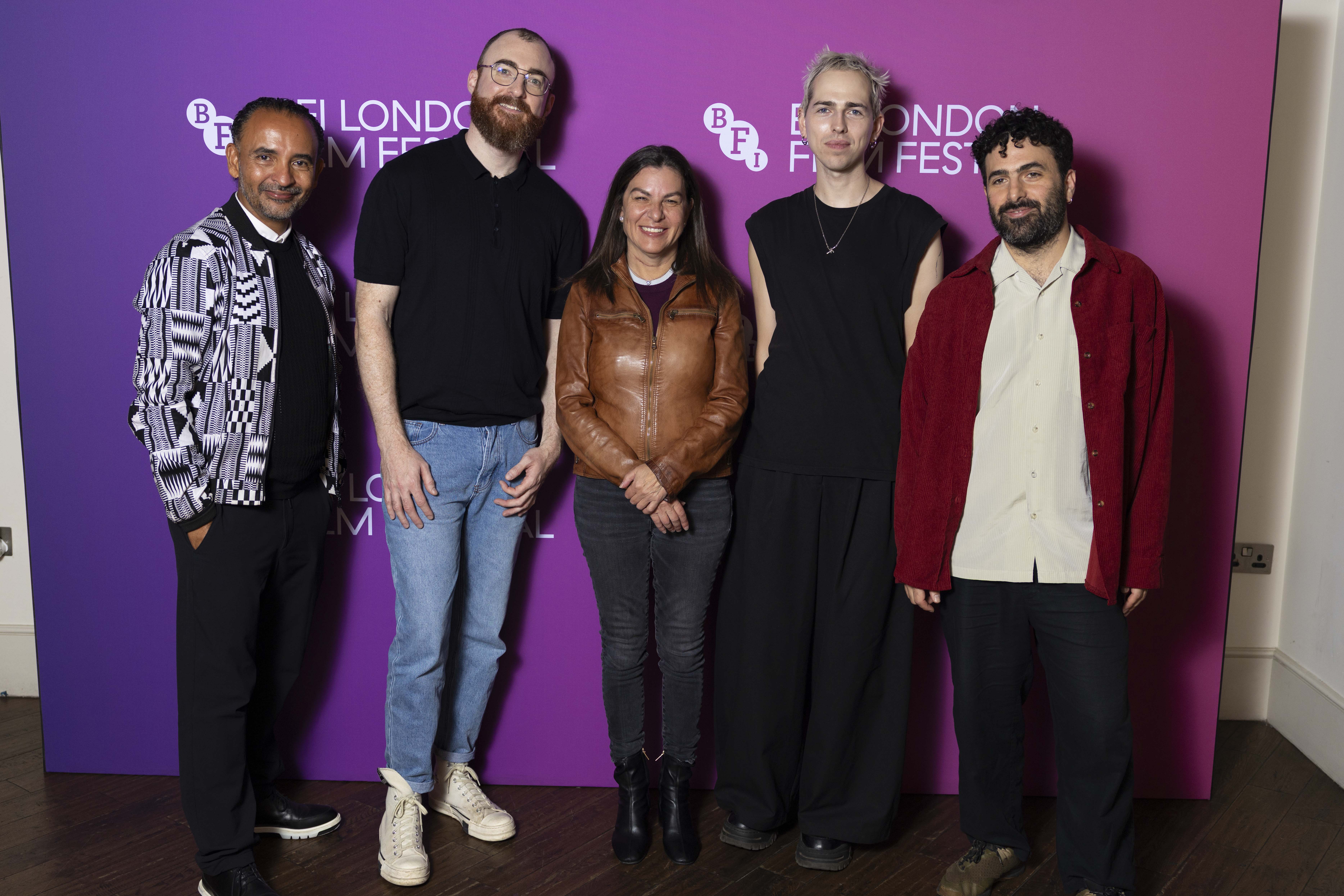
The Industry Panel series at this year’s BFI London Film Festival came to a close with Frame by Frame: Navigating Archives and Storytelling in Documentary Cinema, bringing together filmmakers Nanette Burstein, Rafael Guendelman and Theo Rollason alongside BFI National Archive curator Simon McCallum for a conversation that looked beyond the finished documentary and into the often sprawling process of piecing one together. Across their different projects and experiences, each offered a glimpse into the relationships, discoveries and collaborations that sit behind documentary filmmaking, particularly when so much of the story already exists somewhere within an archive, waiting to be found.
Hosted by Sheffield DocFest Creative Director Raul Niño Zambrano, the conversation explored the many questions that begin to emerge when filmmakers turn to archival footage to tell a story. From those first stages of research and the process of finding material, through to directing and eventually sitting in an edit with what can become an overwhelming amount of footage, the panel returned again and again to the question of how you find a story amongst everything available to you, and how you decide what ultimately deserves a place within it.
Director Nanette Burstein opened the conversation by sharing the inspiration behind her newest documentary, Carl Sagan: We Are Made of Star Stuff, which she described simply as “a love story, a romantic love story which is complicated, but it’s also a love story with science.”
It was a description that seemed to capture the many strands running through the film, which reaches across the history of NASA and the missions Sagan worked on throughout his life, while remaining deeply rooted in the people, relationships and ideas that shaped him.
 *Image: *
Central to that story is Sagan’s wife, Ann Druyan, whose involvement Burstein felt was crucial from the very beginning. Druyan brought with her not only a deeply personal connection to Sagan and his life, but an archive of her own, filled with photographs, home movies and recordings, including tapes capturing Sagan’s thoughts while he was writing one of his books. These fragments became a way of bringing Sagan himself back into the telling of his story, allowing his presence to run through a film made long after his death.
Perhaps one of the most striking moments of Burstein’s recollection came as she spoke about those early conversations with Druyan and the time they spent sitting together, slowly sifting through years of material. In doing so, they began uncovering things that had long been forgotten, and there was something particularly moving in the idea of an archive becoming a place of rediscovery rather than simply a source of information. What had been stored away for years could suddenly be encountered again, not only as a record of a life already lived, but as part of a story still being told.
It is this meeting of the personal and the historical that ultimately forms the documentary, bringing Druyan’s own collection together with archival material from NASA, nature archives and Sagan’s many television appearances. Individually, each offers only a fragment, but placed alongside one another they begin to build something much fuller, allowing the story of Carl Sagan to emerge not only through what he achieved, but through the traces of himself that he left behind.
If Burstein’s experience revealed the intimacy that can be found within an archive, BFI National Archive curator Simon McCallum brought another side of that relationship into the conversation, looking at what it takes to make those discoveries possible in the first place. As part of the team responsible for looking after one of the largest moving image collections in the world, McCallum stressed the importance of involving archivists as early as possible in the filmmaking process, allowing that relationship to become a genuine collaboration rather than something approached only once a film is nearing completion. With documentary projects often drawing material from numerous sources, questions surrounding access and rights can quickly become complicated and time-consuming, and McCallum reflected on how frequently filmmakers leave those conversations until late in production, only to discover that unresolved archival material can bring the process to an unexpected halt.
That idea of the archive as something to work with, rather than simply draw from, carried naturally into Rafael Guendelman’s Az Zeeb. Built around his family’s archive of Super 8 footage, Guendelman brings those images together with newly filmed material, also shot on Super 8, creating what he described as “a conversation through archives, through times and through landscapes.” The result becomes a dialogue between past and present, unfolding into a complex transnational family story that moves through displacement, inherited trauma and political solidarity.
For Guendelman, bringing together the older footage with images he had filmed himself was particularly important. By allowing the two to exist alongside one another, he wanted to explore a “cycle of repetition, creation and destruction” across Chile, Palestine and Israel, while beginning a conversation between landscapes separated by both geography and time. There is something particularly poignant in the choice to capture the present through the same medium that preserved his family’s past, allowing the boundaries between the two to quietly begin to blur and one generation of images to speak to another.
 *Image: *
The use of Super 8 also opened the conversation towards a question that continues to follow both documentary filmmakers and archivists, around how far original footage should be restored, altered or colourised when it is brought into a new work. While opinions will inevitably remain divided, the discussion returned to the importance of allowing a certain degree of flexibility when working with archival material, particularly when doing so allows it to become part of a new story. Rather than seeing an archive as something fixed in the moment in which it was created, the idea of “reactivating” footage became an especially interesting way of thinking about its future, allowing images from the past to take on new meaning in the hands of another filmmaker, another generation or another story.
For McCallum, there is ultimately “no one size fits all” approach to working with archival footage, and perhaps that openness is part of what allows these materials to continue living beyond their original context. He spoke of the BFI National Archive’s ambition to become the most open moving image archive in the world by 2033, something that inevitably requires a sense of “give and take” between the archive and the artists and filmmakers looking to engage with it. Preserving these materials remains essential, but so too does creating the space for them to be rediscovered, reinterpreted and brought into conversation with the stories being told today.
Theo Rollason, the third filmmaker on the panel, brought yet another perspective to that idea through his film Queer Edward II, which follows British filmmaker Derek Jarman and the making of his 1991 film Edward II. Drawing on footage captured on the set of Jarman’s film alongside material from a number of other archival sources, Rollason’s documentary looks beyond the making of Edward II itself and towards the political landscape that surrounded it, exploring how the queer movement of the 1980s and 1990s, and the circumstances in which Jarman and his collaborators were creating, came to inform the film.
For Rollason, it was crucial that Queer Edward II was told entirely through archival footage, allowing the story to remain within the world and moment from which it emerged. The footage, he explained, felt “intimate and present tense, it feels very like you’re there on set, and I wanted to preserve that.” There is an immediacy to this approach that allows the archive to become more than a way of looking back, instead bringing an audience into the atmosphere of the set and amongst the people, conversations and creative energy that surrounded the original film.
Finding that material became a process that stretched across almost the entirety of the documentary’s production. The team began searching through archives before producers had even come on board and continued until only days remained in the edit, eventually drawing from a wide range of collections and sources. Rollason reflected on how important it became to build relationships not only with those who owned and preserved the footage, but also with the people who appeared within it, once again returning the conversation to the deeply collaborative nature of documentary filmmaking.
Those relationships were not without their challenges, particularly when navigating the fees attached to archival material, where even a few seconds of footage could come at a significant cost. It required patience and careful negotiation, but at the heart of those conversations was the creative vision of the project and a shared understanding of the story the filmmakers were trying to tell. When that understanding could be found, it had the potential to bring people together around the material and allow something created decades earlier to find a new life on screen.
The financial reality of working with archives became another important part of the conversation, with the cost of securing footage often sitting alongside rights and access as one of the most difficult aspects of archival documentary filmmaking. BFI archivist Simon McCallum acknowledged that this remains an ongoing conversation within the industry, particularly as commercial libraries can often be more rigid in their rates. Within the BFI National Archive, however, there is an understanding of the importance of conversation and negotiation, and of working with filmmakers wherever possible to help material find its way into the projects that can give it new meaning.
Across the panel, what became increasingly clear was just how many hands, conversations and moving parts sit behind the documentaries we eventually encounter as finished films. An archive may begin with an image, a recording or a reel of Super 8 tucked away for decades, but bringing that material back into the world takes time, patience and an extraordinary amount of consideration. It relies on filmmakers and editors, but equally on archivists, rights holders, families, organisations and the people whose lives exist within the footage itself.
Burstein, Guendelman and Rollason may each be telling very different stories, yet there was something that quietly connected all three. Each had turned towards the past not simply to preserve it, but to understand what it might still have to say. Whether through the forgotten fragments of a life rediscovered in a personal collection, Super 8 images speaking across generations and landscapes, or footage that places us back on a film set more than three decades later, the archive becomes something far more alive than its name might suggest. At the heart of each project is a desire to share a story rooted in what has already happened, while recognising that its meaning does not have to remain there. In the right hands, the past can continue to move, change and speak, finding an impact in the present that feels just as immediate as the moment in which it was first captured.