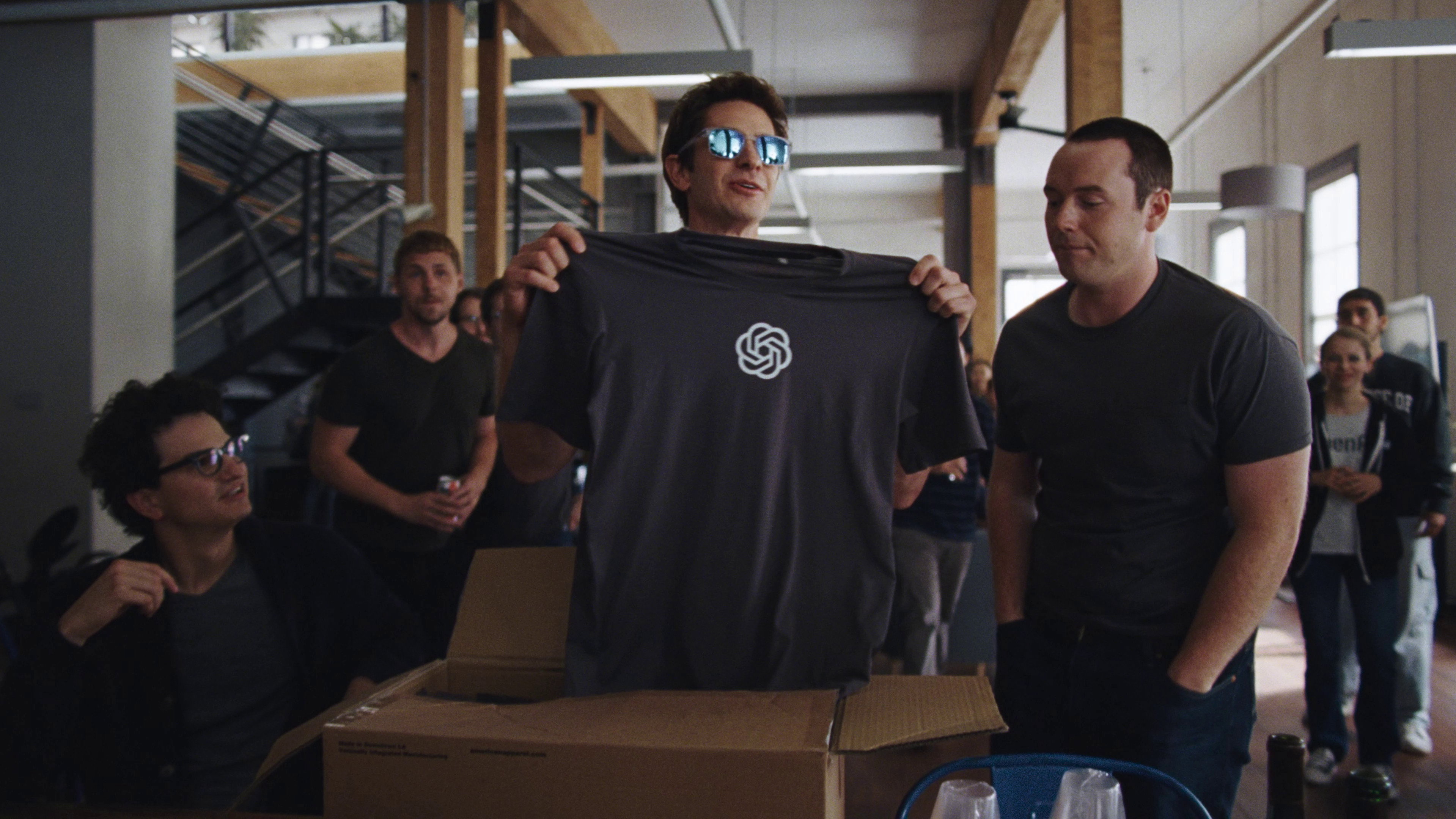
i love the openai team so much
— Sam Altman (@sama) November 19, 2023
Notorious dickhead Sam Altman may have love for the minds behind OpenAI, the American artificial intelligence research company responsible for the world’s latest ruinous invention — and your absolutely unbearable co-worker’s favourite pastime and possible love interest — ChatGPT. But director Luca Guadagnino ("Challengers", "Call Me by Your Name") and SNL alumni turned screenwriter Simon Rich certainly do not. Their hotly anticipated biopic of the most consequential individuals currently walking God’s — for now — green earth is as bleak, depressing and down-right sad as it gets — and I wouldn’t have wanted it any other way.
A portrait of the origins of the contemporary, AI-driven world, "Artificial" spans the course of some twenty years and ostensibly acts as a ‘previously on’ for the events of the Earth’s tech underbelly; seeking to explore and conclude how and why we’ve reached the place that our seemingly doomed society currently finds itself in — and who’s to blame. Real-life tech-guru’s Ilya Sutskever ("Anora" star Yura Borisov), Sam Altman (the once again laptop-smashing Andrew Garfield), fellow notorious dickhead and "Iron Man 2" star Elon Musk ("The Studio"s hilarious Ike Barinholtz), “The Godfather of AI” Geoffrey Hinton (Mark Rylance, as always, at his brilliant best) and many more from Silicon Valley’s den of thieves are depicted as we bear witness to the hellish rise of OpenAI in this instant sign-of-the-times classic.
Now, to indulge myself and my general sense of doom around the ever-growing prospect of the world edging closer and closer to the one depicted in Alfonso Cuáron’s "Children of Men", for just a moment — don’t fear, I’ll keep it brief — I’m pretty concerned about the future. My future. I’m 23, a Masters student in Journalism, and I’m not sure that the world i expected to grow-up in exists anymore. I basically spawned in to the post-Facebook timeline — I’m accustomed to the digital world. But the threat currently posed to both my future career and general quality of life is unlike any i’ve encountered before. I’m not exaggerating when I say that it keeps me up at night; I write this portion of the review in the early hours of the morning, fresh off the back of a few hours of tossing and turning wondering when the terminators are going to strike.
These concerns all came to a head the other day when in class, my professor — who had recently attended a conference on AI in journalism — posed a question to the class. It was something to the tune of: “Do you guys wanna be taught how to use this stuff?” He asked because, to his shock, he learned at the conference that many a university offer modules on that very subject. Not about the threats it poses to journalistic integrity or misinformation, but how we should be utilising this ‘tool’ to better ourselves as spreaders of the seed of knowledge. He seemed as disappointed as I that the question even needed to be asked. And quickly my sorrow turned to anger, my doom-laden thoughts of: Is it over? To: Can I stop this? The answer, after just a few minutes of deliberation, quite clearly, is no. I, a twenty-something, broke, not particularly clever and certainly not very powerful individual— probably — cannot. Though it won't stop me trying.
But this moment of overwhelming fear for the looming doom upon us led me down a path of needing those responsible to be held accountable for the fundamental changes that they have made to the human experience. So you can imagine my pure delight upon stumbling into a press screening at the BFI London Film Festival, still with a clenched fist from the days prior and with a sense of helplessness coursing through my veins, to find that not only were there some conversations being had by some actually rather powerful individuals, but that they felt the very same way as I.
“Artificial” is a scathing, deeply critical and honest portrayal of the very people responsible for the AI generated world that’s being rendered in front of us one water-draining prompt at a time. It pulls no punches, and feels like if not the definitive movie of the 2020s, then at the very least the most unfiltered and raw look at the ones who have shaped it. There really couldn’t be a more timely or urgent film than this right now.
What’s more is that the film’s aggressiveness is often played for laughs. Rich’s comedic sensibility gives us permission to chuckle, nervously, at the world’s descent into hell. He refuses to hold back in his portrayal of these inconsiderate, childish, and megalomaniacal mummy’s boys, but never once does it come at the cost of entertainment; the movie ‘plays’. Striking a rare balance of clever without ever coming across condescending, and having a lot on its mind without losing a sense of direction.
That “Artificial”s New York Film Festival premiere and subsequent London screenings came in the few-day period following “The Social Reckoning”s review embargo lifting and underwhelming wide release, too, only further emphasises the films artistic value by comparison. It’s a beautifully-photographed, artfully-designed, supremely-acted, gorgeously-scored and masterfully-directed movie that lived up to its cinephile-dubbed billing as the potential ‘true’ spiritual successor to David Fincher’s portrayal of another Peter Thiel-funded ruinous invention (Facebook), “The Social Network” — putting to shame Aaron Sorkin’s actual sequel when viewed through every and all artistic avenues.
But even more than its predictably superior level of craft, “Artificial” understands something that “The Social Network” did and “The Social Reckoning” did not: what’s actually important and relevant right now.
What made “The Social Network” such an important cultural artefact, whose legacy as a telling, true, and reflecting piece of work only continues to be further cemented with each passing year, was its understanding of not just what’s already happened and what’s currently happening, but what that meant for our future. It’s turned out, 16 years on, that it was right about absolutely everything it foretold. And though it’s currently unclear just how much of “Artificial”s doom and gloom hypotheses about the rapid rate of which GPT is learning — “it teaches itself”, says Borisov’s Sutskever in the film — it certainly feels, in the moment, that it’s on to something. Whatever that something turns out to be, it’s certainly rather upsetting, and fair to assume that it’s worth contemplation and conversation.
“The Social Reckoning”, by comparison, feels outdated already. Frances Haugen’s Wall Street Journal whistleblowing makes for a damning article, sure. Not exactly anything we didn’t realistically already know or at least suspect. But noteworthy to see in print, no doubt. What it doesn’t make for, or, perhaps more accurately, what it isn’t profound enough to demand, however, is a sequel to one of the century’s most resonant and withstanding dramas. What does is the single most troublesome and anxiety-inducing issue in technological advancement this side of the rise of social media. “Artificial” is just that.
It may not be as revealing about the world as “The Social Network” — time will tell on that front, but it also doesn’t seem to sought to make as many predictions as that movie did — but what it does attempt to do — and succeeds at doing — is just as valuable: understanding how we got here and accepting that maybe we just don’t, and can’t, know what’s to come.
Through the dialogues that the movie opens about the consequences of our actions and the importance of thinking through potential outcomes, it finds itself in conversation not just with “The Social Network” but with “Oppenheimer”, too. Borisov’s Sutskever — down even to the reflective, close-up framing that Guadagnino places him in — is explained, essentially, as to artificial intelligence what J. Robert Oppenheimer was/is to nuclear weaponry. It manages to capture both the weight and seriousness of this individuals mistakes, holding he and everybody else accountable for what truly is a world-altering invention, and the profound impact it’s sure to have going forward. Not bad artistic company to be keeping.
“Artificial” is almost everything it needed to be. Perhaps some slight pacing issues around the halfway point prevent this from ever truly going down the hatchet quite as nicely as “The Social Network”s silky, milk-like texture. But this thicker, possibly less consistent but nevertheless delicious, oat-like treat is a delight. It feels important, it ticks every box artistically, and it captures the essence of the great, big question mark that is AI. Luca hasn’t exactly prevented the forthcoming “War of the Worlds” reenactment that looks to be on the horizon, but he has made it clear who’s responsible — and, for now, that might just be enough.